

Our Blog
Dialysis Access Management
Date : 2024-05-24
Finding out that your kidneys are failing and you need to begin dialysis is scary enough. The last thing you need to worry about at this time is how and where you’ll find an expert who can properly prepare you for the daily lifesaving treatments that may continue for weeks or months. In order to provide proper dialysis, you need an access point all ready for the technicians to administer the treatments. Discovering the best access for your needs, then creating and providing you with that entry point is a specialty of the Astra Vein Treatment Center in Brooklyn and Bronx. Dr. George Bolotin also provides ongoing dialysis access management as needed. Stop worrying about the technicalities and rely on the best in the field. Call today for an appointment.
What Is Dialysis Access?
Dialysis access refers to a method used to reach the blood in your body to accommodate efficient and successful hemodialysis treatments. If you’re living with end-stage renal disease (ESRD) or other kidney diseases, you need dialysis treatment to clean your blood. Vascular access methods provide access to the blood in your body, so it can be run through an external dialysis machine.
When your kidneys fail, your health care practitioner uses a dialysis machine to remove excess fluid and toxins from your blood. The filtered blood then flows back into your body, allowing optimal body functions. A well-functioning dialysis access point handles adequate blood flow for the most effective dialysis treatment while reducing the treatment time. It’s a lifeline to treatment and good health.
Why Is Dialysis Access So Important?
Having the proper dialysis access is vital to your ongoing treatments in a number of ways, including:
- Promoting a steady stream of blood flowing into the machine
- Requiring very little maintenance, making your treatments easier overall
- Making all the difference in your overall ESRD treatment, as well as your peace of mind and mental health
To receive the correct access processes for your unique needs, rely on an expert in the field of vascular diagnosis and treatment. At the Astra Vein Treatment Center in Brooklyn, NY and Bronx, NY Dr. George Bolotin is an experienced vascular specialist, who uses the latest technology to review the veins and arteries. With a background in Interventional Radiology, he determines the best dialysis access for you.
What Are the Options for Dialysis Access?
Every case of ESRD is unique, so your dialysis access depends on several factors. These factors include the condition of your veins, as well as the urgency with which you need to begin dialysis. Dr. Bolotin has a number of dialysis access options to choose from, including:
- Central venous access catheter (CVAC). This type of vascular access comprises a flexible, long, plastic, Y-shaped tube. Your vascular specialist makes a small incision in your neck, chest or groin to gain access to your bloodstream. The tube is then inserted through your skin into a central vein. This dialysis access option is necessary if you need immediate or emergency dialysis.
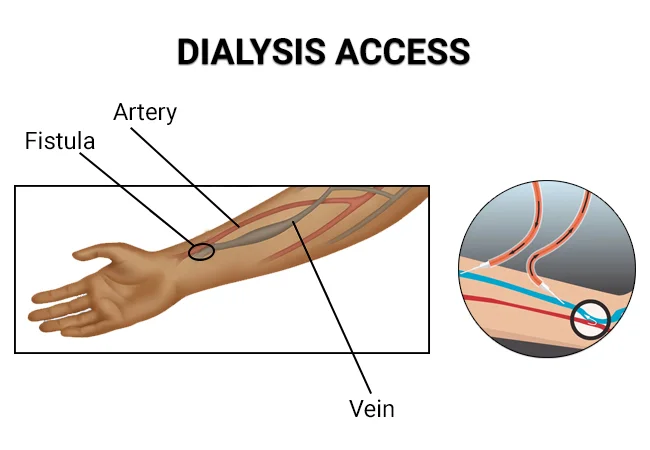
- Arteriovenous fistula (AV fistula). This is a highly effective surgical access created by connecting an artery with a vein. The connection gives your patient care technician (PCT) access to high-pressure and high-flow blood for effective hemodialysis treatment. AV fistula is the most effective dialysis access. It’s a low-risk, permanent solution for dialysis treatment. It does, however, take several months for the connection to mature for use in dialysis.
- Arteriovenous graft (AV graft). An AV graft works for ESRD patients whose veins are weak or thin and for those who need dialysis urgently. Your specialist connects a tube to an artery and vein to get access to high-flow blood. The vein and artery aren’t connected directly, and it takes several weeks to heal. When considering AV fistula vs. an AV graft, your doctor considers all your needs before making a recommendation.
- Peritoneal dialysis catheter (PD catheter). Peritoneal dialysis differs from hemodialysis. It uses the belly lining and a dialysate solution to filter blood. You need a PD catheter for this dialysis access.
Once you get a diagnosis of ESRD, find the best source for a dialysis access procedure Dr. Bolotin, your vein specialist in Brooklyn and Bronx, offers personalized attention to ensure you get the right dialysis access for your hemodialysis treatment. The team at this Brooklyn and Bronx vein center has the expertise and technology to provide you with the best solutions.
Astra Vein Treatment Center
869 E Tremont Ave,
Bronx, NY, 10460
(929) 447-4563
Web Address https://www.astraveinvascular.com/
Google maps: https://goo.gl/maps/1kdUTGGCoTnjtNnb8
Nearby Locations:
Crotona | Claremont | Crotona Park East | Charlotte Gardens | Van Nest | Soundview
10459 | 10460 | 10462
Working Hours:
Monday: 9am – 6pm
Tuesday: 9am – 6pm
Wednesday: 9am – 6pm
Thursday: 9am – 6pm
Friday: 9am – 6pm
Saturday: Closed
Sunday: Closed
Payment: cash, check, credit cards.
Pelvic Congestion Syndrome (PCS) Treatment
Date : 2024-05-24

Pelvic pain can stop you from enjoying all the activities you used to do, from bike-riding to playing with the children. Often misdiagnosed, your pelvic pain may be the result of pelvic congestion syndrome (PCS). It’s considered a varicose vein inside your pelvis, so it restricts blood flow back to your heart. Call on Dr. George Bolotin of the Astra Vein Treatment Center in Brooklyn, NY and Bronx, NY. He’s an expert in Interventional Radiology, the perfect practice to diagnose and treat PCS.
What Is Pelvic Congestion Syndrome?
Pelvic congestion syndrome or PCS describes a chronic pelvic pain that affects many women in the US. The pain may radiate from within your pelvis, the lower area of your abdomen between your hips. PCS occurs frequently in women during their fertile years and is very common in women who have given birth to multiple children.
The veins in your pelvis are responsible for transporting deoxygenated blood back to your heart. When they malfunction, blood starts to build up in them, which is usually the cause of your pain. The veins distort and change shape, much like varicose veins on the surface of your skin. Eventually, those veins cause you pain.
This problem for women results in approximately 10 to 15 percent of visits to pain clinics and gynecologists. If you’re suffering from PCS, visit Dr. George Bolotin at the Astra Vein Treatment Center in Brooklyn, New York and Bronx, New York. He diagnoses all types of vein conditions and provides unrivaled pelvic congestion treatment.
What Are the Symptoms of Pelvic Congestion Syndrome?
You may not experience PCS until you’re pregnant, but it may continue to bother you afterward. The most obvious symptom is chronic pelvic pain. Your vascular Brooklyn and Bronx vein doctor may recommend a pelvic congestion syndrome ultrasound if your pain is extreme to better diagnose your condition.
With PCS, the pain in your pelvis tends to increase throughout the day, especially if you have to sit or stand at work for long periods. Fortunately, the pain tends to diminish after a night’s sleep. Other factors that can increase your pain include:
- Sexual intercourse, but pain during sex is a symptom of fibroids, as well
- Menstruation, although severe menstrual cramps are another sign of fibroids
- Certain exercises that rely on your hips, such as riding a horse or a bicycle
How Is Pelvic Congestion Syndrome Diagnosed?
Until recently, successful PCS treatment had been rare due to incorrect diagnoses and a poor understanding of the condition’s vascular causes. Many of the symptoms of pelvic syndrome are the same as other medical conditions. Even today, malfunctioning veins in your pelvis often defy proper diagnosis.
As a specialist in Interventional Radiology, Dr. Bolotin uses imaging tests, such as with a pelvic congestion syndrome ultrasound, to make an accurate diagnosis and even perform treatments. He recognizes the slight differences in your symptoms between vein conditions and fibroid conditions because he is an expert in and treats both.
Astra Vein Treatment Center
869 E Tremont Ave,
Bronx, NY, 10460
(929) 447-4563
Web Address https://www.astraveinvascular.com/
Google maps: https://goo.gl/maps/1kdUTGGCoTnjtNnb8
Nearby Locations:
Crotona | Claremont | Crotona Park East | Charlotte Gardens | Van Nest | Soundview
10459 | 10460 | 10462
Working Hours:
Monday: 9am – 6pm
Tuesday: 9am – 6pm
Wednesday: 9am – 6pm
Thursday: 9am – 6pm
Friday: 9am – 6pm
Saturday: Closed
Sunday: Closed
Payment: cash, check, credit cards.
